
4 December 2023 · 5 min read · Asbestos Removal
In the quest for durable, fire-resistant building materials, asbestos was widely used in Australian construction until its dangers became impossible to ignore. Today, as Wollongong homeowners contemplate demolishing or renovating structures built before the late 1980s, understanding where asbestos hides — and why professional removal is non-negotiable — can protect your health, your budget, and your legal standing.
Where Is Asbestos Commonly Found in Australian Homes?
Asbestos-containing materials (ACMs) are not confined to one part of a building. In homes constructed before the 1990s, ACMs can appear in almost every major component:
- Roofing — corrugated asbestos cement sheets, flat sheets, and roof shingles were widely used for their fire-resistant properties. Many homes across Wollongong and the Illawarra built before 1990 may still have original asbestos roofing.
- Wall cladding — asbestos cement sheets (sometimes called fibro or fibrous cement) were used extensively for external wall cladding and internal lining. Disturbing this material during renovation or demolition without proper precautions can release hazardous fibres.
- Flooring — vinyl tiles and linoleum from the pre-1980s era often contained asbestos, and the adhesives used to fix them frequently did too. These are among the most commonly overlooked ACMs in domestic properties.
- Insulation — loose-fill and batt-form asbestos was used in ceiling spaces and wall cavities for its heat-retaining and fire-resistant qualities. Loose-fill asbestos is considered friable (easily crumbled) and is among the most hazardous forms.
- Wet areas — bathrooms, laundries, and kitchens in older homes often feature asbestos sheeting behind tiles and around plumbing penetrations.
- External structures — fencing, sheds, and eaves constructed with asbestos cement sheeting were common in Australian backyards from the 1950s through to the mid-1980s.
Why Is Asbestos Dangerous During Demolition and Renovation?
Asbestos that is in good condition and left undisturbed poses a lower immediate risk. The danger arises when ACMs are cut, drilled, sanded, water-blasted, or broken — activities common in both renovation and demolition. When asbestos fibres become airborne, they can be inhaled and become permanently lodged in the lungs, leading to serious diseases including mesothelioma, asbestosis, and lung cancer. These diseases have a long latency period — sometimes decades — which is why exposure at any stage of life must be taken seriously.
What Are the Legal Requirements for Asbestos Removal in NSW?
SafeWork NSW regulations are clear: any asbestos removal work exceeding ten square metres of non-friable material must be carried out by a licensed asbestos removalist. Friable asbestos (material that can be crumbled by hand pressure) must always be removed by a licensed Class A removalist, regardless of the quantity.
Before any structure built before 1990 is demolished in NSW, an asbestos inspection and register must be completed by a licensed asbestos assessor. This legal requirement protects workers, neighbours, and future occupants. Attempting to demolish or renovate without this step can result in significant fines under the Work Health and Safety Act 2011.
How WCED Manages Asbestos Removal Safely
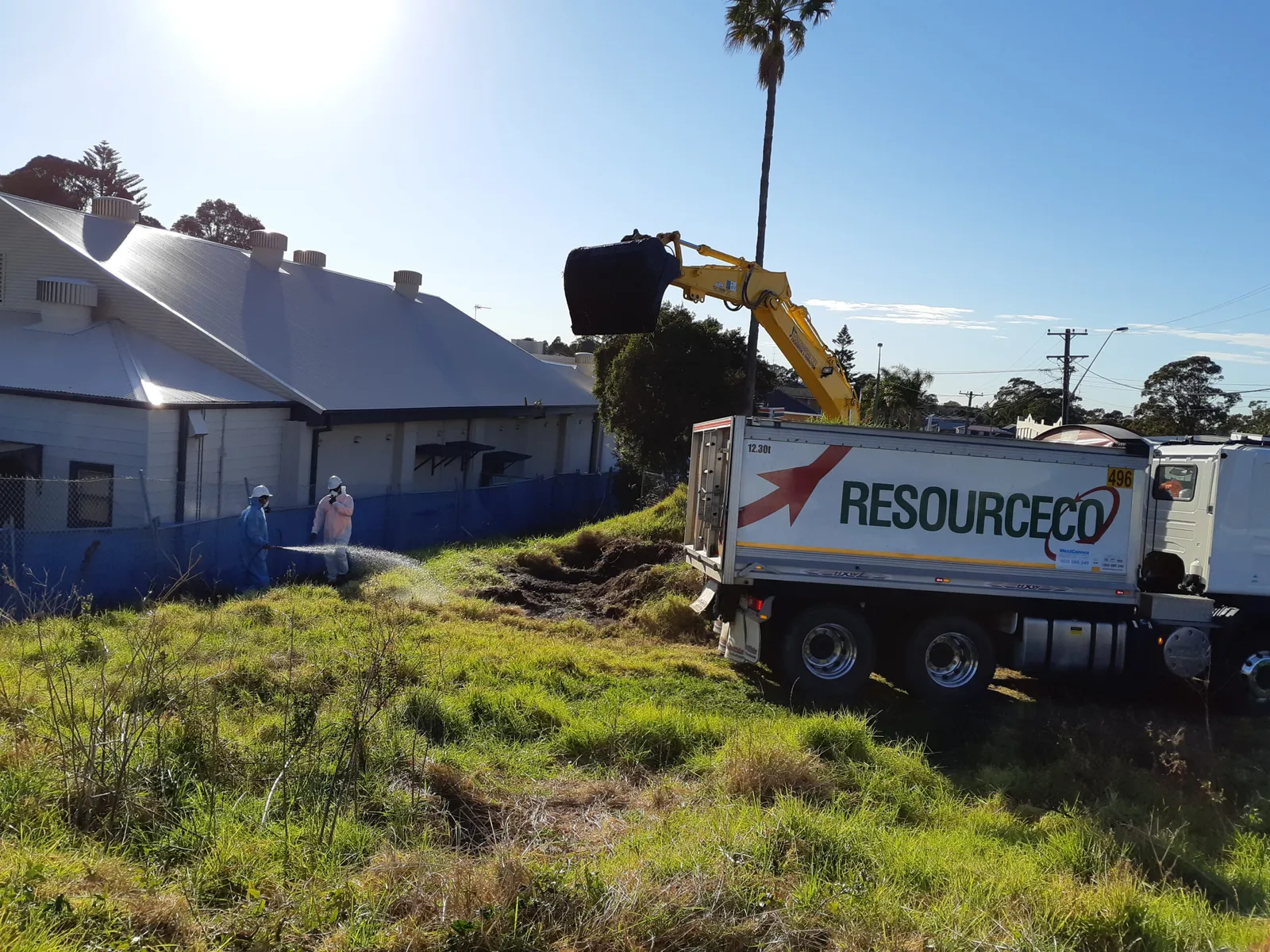
Wollongong City Excavation & Demolition holds a Non-Friable Asbestos Removal Licence (AD213027) issued by SafeWork NSW. Our process begins with a thorough pre-demolition inspection, and we work alongside licensed asbestos assessors to ensure all ACMs are identified, safely removed, and disposed of at a licenced waste facility before mechanical demolition commences.
We also carry out asbestos removal as a standalone service for homeowners undertaking renovations — including fibro wall removal, asbestos roof replacement preparation, and removal of asbestos eaves and fascias. If you suspect your Wollongong or Illawarra home contains asbestos, contact WCED before you or your tradesperson disturbs anything.
Frequently asked questions
- How do I know if my house has asbestos?
- If your home was built or renovated before 1990, it very likely contains some form of asbestos. The only way to confirm is to have a sample tested by a NATA-accredited laboratory. A licensed asbestos assessor can take samples safely and produce an asbestos register for your property.
- Can I remove asbestos myself in NSW?
- You may remove up to ten square metres of non-friable asbestos yourself under NSW law, but this is generally not advisable without the correct PPE and disposal arrangements. Any friable asbestos, or quantities above ten square metres, must be removed by a licensed contractor.
- How is asbestos waste disposed of?
- Asbestos waste must be double-wrapped in heavy-duty plastic, clearly labelled, and transported to a licenced asbestos waste facility. In NSW, it cannot be disposed of in standard skip bins or taken to a general landfill. Licensed contractors manage this process end to end.
- Does WCED offer asbestos removal for renovation projects, not just demolition?
- Yes. WCED carries out asbestos removal as a standalone service for homeowners and builders — including fibro wall sheeting, asbestos roofs, eaves, and bathroom linings — in preparation for renovation or extension work across the Illawarra.
- What is the difference between friable and non-friable asbestos?
- Non-friable asbestos is bonded within a solid matrix (such as cement sheet) and is less likely to release fibres when undisturbed. Friable asbestos can be crumbled by hand pressure and releases fibres much more readily — making it significantly more hazardous. Friable asbestos must only be removed by a licensed Class A asbestos removalist.