
23 December 2021 · 4 min read · Demolition
Knockdown rebuilds have become one of the most popular paths to a new home in Wollongong and the broader Illawarra. The city is one of Australia's fastest-growing regional centres, attracting buyers from Sydney who arrive with equity and ambitions — and find a stock of older houses built in the 1960s–80s that are ready for renewal. If you are considering demolishing your home and starting fresh, here is everything you need to know before the excavator arrives.
Do You Need a Development Approval to Demolish in Wollongong?
The first step in any Wollongong house demolition is understanding your approval pathway. In NSW you have two main options: a Development Application (DA) lodged with Wollongong City Council, or a Complying Development Certificate (CDC) processed by a private certifier under the State Environmental Planning Policy (Exempt and Complying Development Codes) 2008.
A CDC is often the faster route for straightforward residential demolitions — an accredited private certifier can issue approval in as little as two weeks when the project satisfies the CDC criteria. A DA is required for more complex sites: heritage-listed properties, lots in areas with special environmental restrictions, or demolitions that trigger Council's own development controls. Requirements vary from council to council, so it pays to confirm your site's zoning and any overlay controls before you start planning.
What About Trees on My Property?
Tree removal is one of the most overlooked costs in a knockdown rebuild. Every local council has its own tree preservation order (TPO), and Wollongong City Council is no exception. Removing certain trees — typically those above a set height or trunk girth — requires a separate permit or must be included in your DA. Fines for unlawfully removing a significant tree can be substantial, so it is vital to seek advice before cutting anything down.
When WCED conducts a demolition, our team walks the site and flags any trees that are likely to require an arborist's report or council approval before removal. Trees larger than three metres also add to the cost of the demolition itself: the tree and stump must be removed by a qualified arborist, green waste disposed of separately, and the resulting void compacted correctly before construction can begin.
What Does the Demolition Process Actually Involve?
Once approvals are in place, a standard residential demolition in Wollongong typically follows these stages:
- Pre-demolition asbestos inspection — mandatory for any home built before 1990. A licensed asbestos assessor inspects the structure and produces a report. If friable or non-friable asbestos is found, it must be removed by a licensed contractor before demolition machinery moves on site.
- Service disconnections — your energy retailer, Sydney Water, and gas provider must be notified and mains disconnected. WCED can advise on the correct sequence.
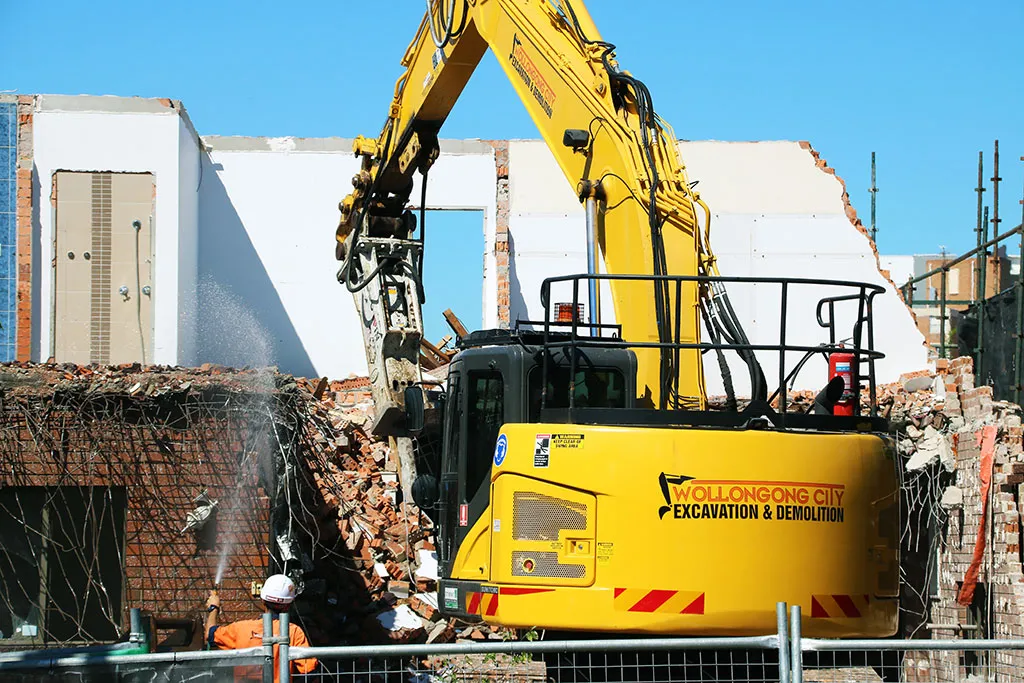
- Demolition of the structure — mechanical demolition with excavators for most residential homes; hand strip-out where neighbouring structures or confined access demand a slower, more controlled approach.
- Waste sorting and removal — materials are sorted on site. Recyclables such as brick, concrete, steel and timber are diverted from landfill. Hazardous waste (asbestos, chemicals) is disposed of at licenced facilities in accordance with NSW EPA requirements.
- Site clean and level — the block is graded to a clean, level finish ready for your builder.
Why the Right Contractor Matters
No two demolitions are the same. The structure's materials, the site's accessibility, neighbouring properties, trees, underground services, and the presence of hazardous materials all affect how the job is priced and managed. Wollongong City Excavation & Demolition has been operating in the Illawarra since 2014 and holds a SafeWork NSW Restricted Demolition Licence (AD212589) and a Non-Friable Asbestos Removal Licence (AD213027). Our team is experienced in identifying on-site risks early, so there are no surprises for you or your builder when construction begins.
If you are planning a knockdown rebuild in Wollongong, Shellharbour, Nowra, or anywhere across the Illawarra, we would love to talk through your project and provide an obligation-free quote.
Frequently asked questions
- Do I need council approval to demolish my house in Wollongong?
- Yes. You will need either a Complying Development Certificate (CDC) from a private certifier or a Development Application (DA) approved by Wollongong City Council. A CDC is available for most straightforward residential demolitions and can be processed in as little as two weeks.
- Can I remove trees from my property before demolition?
- Not necessarily. Wollongong City Council's Tree Preservation Order requires approval before removing trees above certain sizes. Your demolition contractor or an arborist can advise which trees need a permit and incorporate this into the project timeline.
- Does my house need an asbestos inspection before demolition?
- Yes — this is a legal requirement for any structure built before 1990 in NSW. A licensed asbestos assessor must inspect the building and produce a report before demolition commences. If asbestos is found, it must be removed by a licensed contractor (such as WCED) prior to mechanical demolition.
- How long does a residential demolition take in Wollongong?
- A straightforward single-storey house typically takes one to three days of machine demolition, plus time for service disconnections and asbestos removal if required. Complex sites with restricted access, multiple structures, or hazardous materials take longer.
- Who is responsible for disconnecting services before demolition?
- The property owner is responsible for arranging disconnections with their energy retailer, Sydney Water, and gas provider. Your demolition contractor can advise on the correct order of operations, and some will manage service notifications on your behalf.